
Data centers have quickly become one of the most discussed issues in Yankton County, but there is still a great deal the public does not know.
Some people have claimed on Facebook that local landowners are being approached about selling or leasing property for a data center. Others have insisted that nobody is making those offers.
Unless someone is part of every private conversation taking place throughout the county, it is impossible to know with certainty that no landowner has been approached. At the same time, secondhand statements and anonymous social media comments are not enough to confirm that an offer has been made.
That could change if a landowner, developer or another person directly involved comes forward publicly or provides documentation.
What can be confirmed, according to Yankton County Development Services Director Gary Vetter, is that the county has received an inquiry related to possible data center development. The county has not received a formal application.
Meanwhile, the Yankton County Commission has approved a six-month moratorium on certain data center permits. The Planning Commission is preparing to study possible permanent regulations, and supporters of a separate proposed ordinance have been circulating an initiated-measure petition.
These are two different processes, but both could help determine how future data center proposals are handled in Yankton County.
What Is a Data Center?
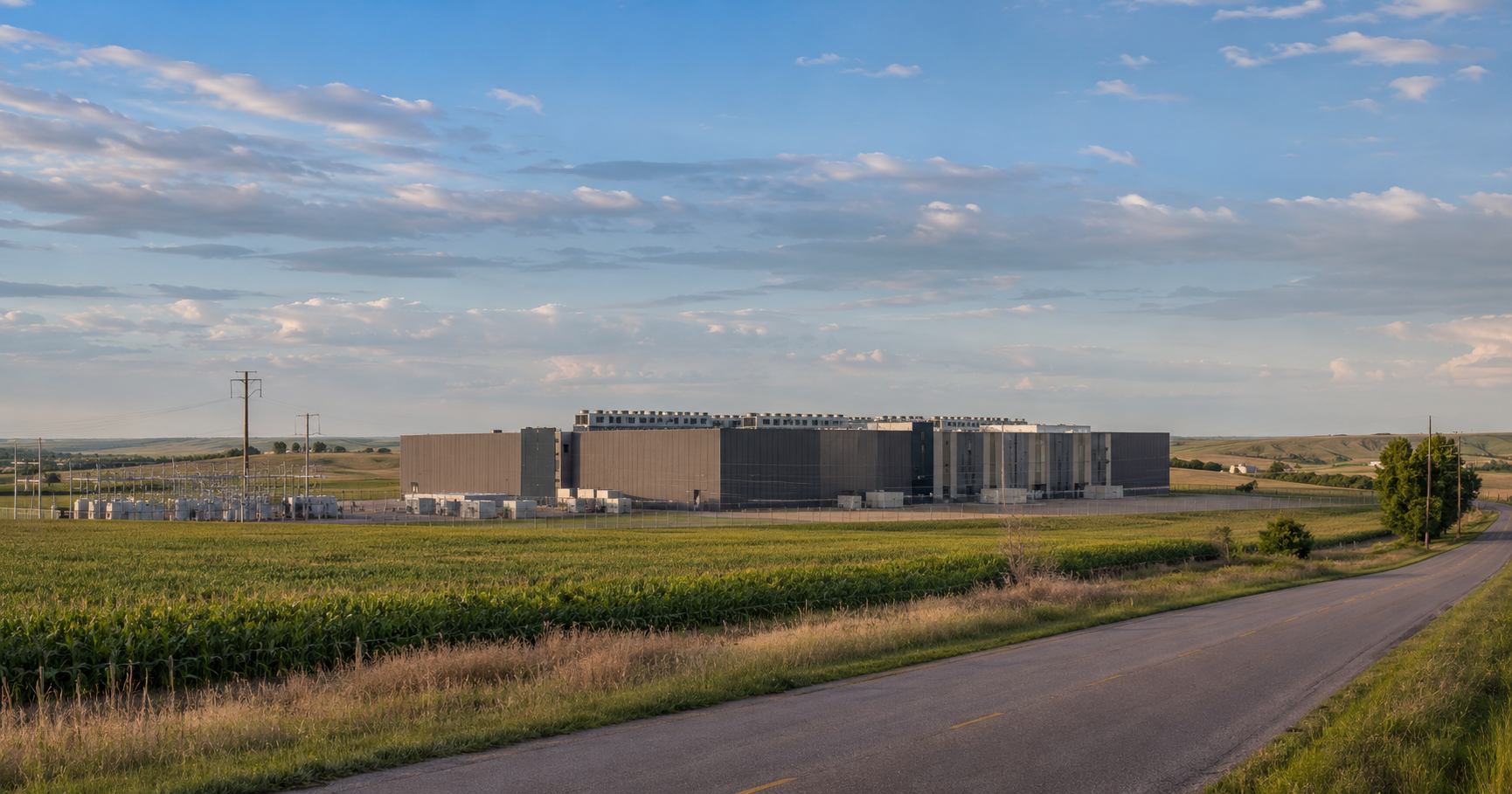
A data center is a building or group of buildings containing computer servers, storage systems and other equipment used to store, process and distribute digital information.
Data centers support services people use every day, including banking, internet searches, cloud storage, streaming services, social media, business records and artificial intelligence. They can also support cryptocurrency mining, weather modeling, scientific research and other uses requiring significant computing capacity.
Not all data centers are alike. They can vary greatly in size, purpose, cooling system, electricity demand and water use.
A smaller regional facility should not automatically be compared to a massive data center campus requiring hundreds of megawatts of power. Those differences are important when evaluating potential effects on utilities, water supplies, noise, infrastructure and neighboring properties.
Timeline: How the County Reached This Point
June 16: Proposed 12-Month Moratorium Presented
Commissioner Ryan Heine presented a proposed 12-month moratorium during the June 16 Yankton County Commission meeting.
The proposal would have temporarily stopped the county from accepting applications or issuing building, planning, use, zoning or rezoning permits for data centers and Bitcoin-mining facilities exceeding 250 kilowatts of power capacity.
The draft identified electricity demand, water use and noise as issues the county wanted time to study.
Several residents spoke during the discussion. Drew O’Brien of A1 Development Solutions, Paul Mantz representing NorthWestern Energy and Scott Sandal also addressed the commission.
The proposal was discussed, but no moratorium was adopted that evening.
July 7: Public Notice Required Before Action
The moratorium returned to the County Commission on July 7.
During the meeting, Commissioner Wanda Howey-Fox raised the public notice and hearing requirements contained in South Dakota law.
SDCL 11-2-10 allows a county to adopt temporary zoning controls while conducting studies or considering changes to its comprehensive plan. Before temporary controls may be adopted, the county must hold at least one public hearing and publish notice of that hearing at least 10 days in advance.
A motion by Heine to approve the moratorium immediately did not receive a second. Howey-Fox then moved to publish notice of a public hearing. That motion passed 4-0, with Heine abstaining.
The hearing was scheduled for July 21.
July 11: Public Hearing Notice Published
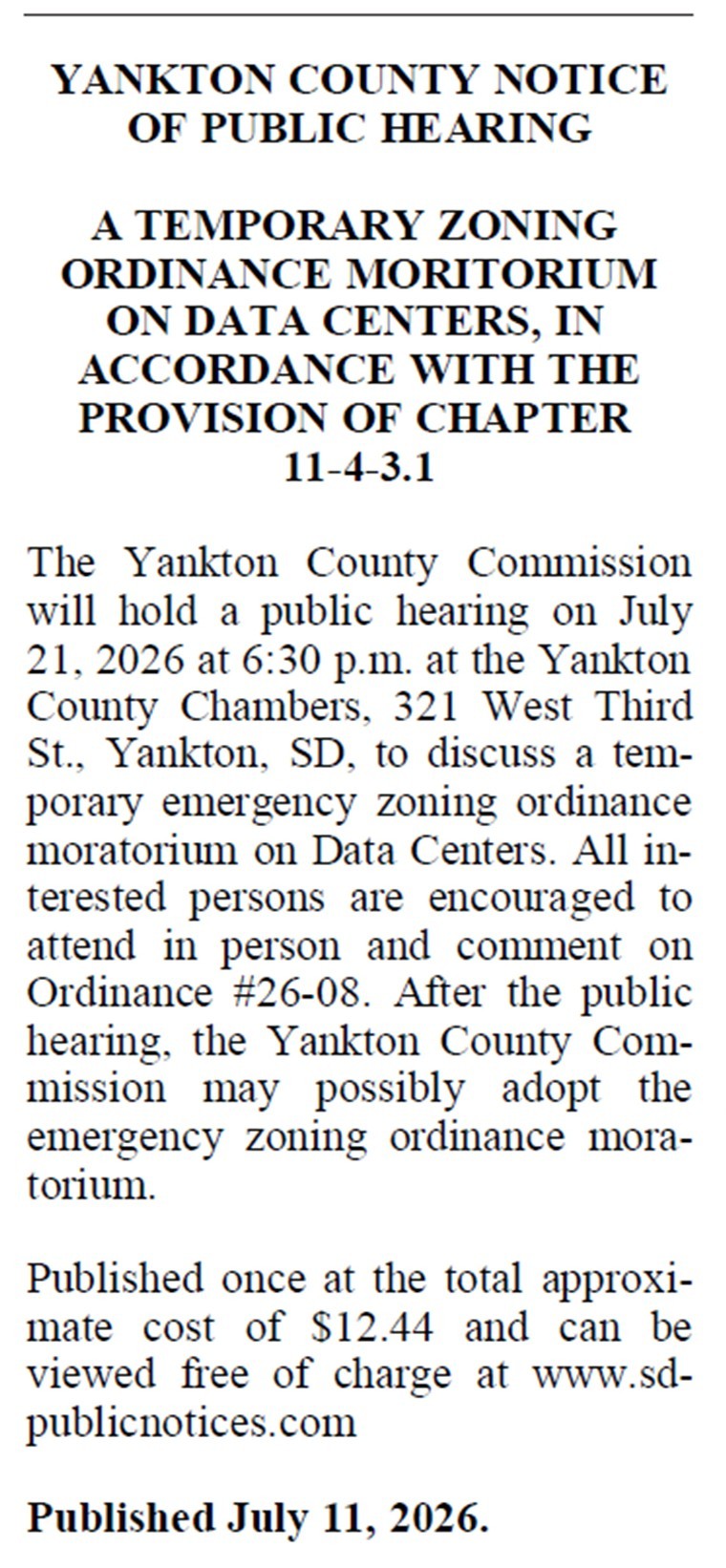
A notice published July 11 announced that the County Commission would hold a public hearing at 6:30 p.m. July 21 concerning Ordinance No. 26-08, described in the notice as a temporary emergency zoning ordinance moratorium on data centers.
The notice invited members of the public to attend and comment before the commission acted.
July 21: Six-Month Moratorium Approved
Following a public hearing that included nearly an hour of public comments, commissioners reduced the proposed moratorium from 12 months to six months.
The commission then unanimously approved Resolution No. 26-7, with five votes in favor and none opposed.
The resolution took effect July 21. The commission may consider extending it if permanent regulations have not been completed by the end of the six-month period.
What the Moratorium Does
Resolution No. 26-7 states that Yankton County will not accept applications or issue building, use, zoning or rezoning permits specifically for data centers or Bitcoin-mining facilities exceeding 250 kilowatts during the moratorium.
Applications and permits may continue for other legally permitted uses not covered by the resolution.
Gary Vetter, Yankton County Development Services Director, said in a written response that, according to the state’s attorney, the moratorium is not an injunction and will not prohibit projects from proceeding.
The resolution clearly prevents the county from accepting or issuing the permits it identifies. However, it does not appear to prevent private planning, research, site evaluation or land discussions that do not yet require county approval.
The Heartland Community Ledger has requested additional clarification about whether the county could receive, review or approve any portion of a data center proposal during the moratorium.
What Is Known About Possible Interest in Yankton County?
Vetter confirmed that the county has received an inquiry related to possible data center development but has not received a formal application.
He also said the county is not aware of Yankton County landowners who have been contacted about selling or leasing property for a data center.
That answer tells us what county officials currently know. It cannot establish whether private conversations have occurred without being reported to the county.
Julie Auch, who has been involved in organizing the initiated-measure petition, said her concern began after she received a telephone call from a current Yankton County commissioner regarding the possibility of a 10- to 20-megawatt data center coming to the county.
Auch did not identify the commissioner in her written response. Her statement does not establish that a location has been selected, a land offer has been made or a developer has decided to build here.
At the June 16 meeting, O’Brien said there was no specific project and that he was evaluating possible locations in eastern South Dakota.
Commission Chairman John Marquardt also referred publicly to the possibility of a 10- to 20-megawatt development during the July 21 discussion while distinguishing it from a much larger 500-megawatt project.
The information available so far points to an inquiry or preliminary interest—not a filed development proposal.
What the County Plans to Study
Vetter said research by county staff and the Yankton County Planning Commission has already begun.
The Planning Commission is scheduled to discuss data centers at its August 11 meeting. It is expected to review the county’s moratorium, ordinances drafted or adopted by other counties and information provided by residents and other sources.
Possible subjects include air quality, setbacks, buffering, decommissioning, emergency response, electricity use, environmental effects, building height, lighting, noise, screening and water use.
Scott Sandal, vice president of client services with Sunbird Services, is scheduled to give a presentation at the August 11 meeting.
Vetter said each public meeting will include time for public input.
Whether six months will be enough time will depend on several factors, including whether the Planning Commission schedules additional meetings, creates subgroups, seeks professional or industry input and receives extensive public comments.
If the Planning Commission develops an ordinance, its recommendation will proceed through the required public notice and hearing process before reaching the County Commission.
Vetter identified several potential benefits that data center development could bring to Yankton County, including job creation, significant tax revenue, infrastructure development, technological development and national-security benefits from keeping data infrastructure within the United States.
He said the County Commission would ultimately be responsible for determining whether those potential benefits outweigh the possible costs and risks.
Why a Citizen Ordinance Is Also Being Proposed
While the county begins its research, Auch and other residents have been circulating an initiated-measure petition containing a proposed ordinance called Article 30.
Auch said she initially recommended a 12-month moratorium so the county would have time to prepare regulations.
She believes regulations should be established before a formal project is presented, rather than developed after a specific proposal has already begun moving forward.
Auch compared the issue to the county’s regulation of concentrated animal feeding operations, commonly known as CAFOs. Her position is that if the county regulates one type of large development on agricultural land, it should also establish standards for data centers.
Auch emphasized that she is not opposed to economic development or the free market. She said Article 30 is intended to protect landowners who may want a data center on their property while also protecting neighboring property owners and other county residents.
“When a large industry will affect the lives of potentially all the residents, it is a serious question, and we the people deserve to have regulations in place for our protection,” Auch said.
The initiated-measure process gives residents a way to propose an ordinance directly. The petition states that Article 30 should be submitted to Yankton County voters for approval or rejection.
The county’s moratorium and the initiated-measure petition should not be confused. The moratorium is temporary and gives the county time to study the issue. Article 30 proposes permanent regulations.
What Article 30 Would Do
The proposed Article 30 is not a ban on data centers, and it does not approve or reject a specific project. It would establish permanent county requirements for future data center proposals.
In summary, Article 30 would:
- Limit data centers to commercial or industrial permitted-use areas.
- Require a conditional-use permit and a county building permit.
- Establish a one-half-mile setback from homes, schools, religious institutions and public parks, with a process for requesting a variance.
- Require fencing, screening and sound barriers around generators.
- Establish daytime and nighttime noise limits and require a noise-mitigation plan.
- Require utility verification that the electrical system has enough capacity to safely serve the facility.
- Require certified information about expected electricity and water use, drainage, runoff, site design and nearby properties.
- Require sufficient access for emergency vehicles.
- Establish certain restrictions involving foreign ownership, operations, equipment and contracts.
- Require a plan and financial responsibility for decommissioning the facility and restoring the property when operations end.
The full proposed ordinance contains the specific definitions, measurements and application requirements and will be attached to this article so readers can review it directly.
Possible Benefits of Data Centers
Supporters of data center development argue that these facilities can bring substantial private investment, construction work, permanent employment, tax revenue and infrastructure improvements.
Data centers also provide the physical infrastructure required for services that have become part of everyday life. Demand for digital storage and processing continues to grow, particularly with the expansion of artificial intelligence.
From that perspective, establishing reasonable regulations could allow a county to benefit from development while making its expectations clear before a company invests in a site.
However, the potential benefits would depend on the size and type of facility, the number of permanent jobs created, any public incentives offered and the amount of tax revenue that would remain locally.
Those details cannot be evaluated until an actual proposal is submitted.
Concerns Being Raised Across the Country
The concerns being discussed in Yankton County are not unique.
Communities across the country are examining electricity demand, water consumption, noise, backup generators, air emissions, emergency-response needs, effects on neighboring properties, infrastructure costs, public incentives and responsibility for removing facilities when they close.
Those concerns are legitimate subjects for public discussion, but the effects are not identical for every data center.
A study by Virginia’s Joint Legislative Audit and Review Commission found that water consumption varies depending on a facility’s size, computing density and cooling system. Many facilities studied used no more water than a large office building, while a smaller number used substantially more.
Some data centers use evaporative cooling. Others rely primarily on air cooling, recycled water or closed-loop systems. A proposal’s actual water source and cooling design would need to be known before its local effects could be evaluated.
Electricity demand is also receiving national attention. The U.S. Department of Energy reported that data center electricity use has tripled over the past decade and could double or triple again by 2028.
That does not prove that a particular Yankton County facility would overwhelm the electrical grid. It does demonstrate why the size of a proposal and verification from the utility provider are important.
What Elon Musk Said About Water
A video clip involving Elon Musk and data center water concerns has circulated online. However, I could not verify that Musk said data centers are causing a water crisis.
Musk has publicly supported the opposite argument. He responded “True” to a post claiming that data center water use is small compared with the amount of water consumed by American golf courses.
Musk’s response represents one side of the debate. He is also the owner of xAI, which operates large computing facilities.
His statement does not establish that water consumption is never a concern. It does demonstrate why a short social media clip should not be treated as complete evidence without locating the original statement and its context.
The amount of water used depends on the specific facility, its cooling system, climate, local water source and electricity supply.
Without details about an actual proposal, it would be premature to say that a Yankton County data center would cause a water crisis. It would also be premature to say that water use could not become a concern.
What Happens Next?
No permanent Yankton County data center ordinance has been adopted, and no formal application has been filed.
The six-month moratorium is now in effect. The Planning Commission is scheduled to begin its public discussion August 11.
The citizen petition proposes a separate ordinance. If the petition is submitted and meets the requirements of South Dakota law, it will proceed through the county initiative process.
Until more information becomes available, residents should distinguish between information confirmed through public documents, statements made by identified people with direct knowledge and claims repeated through social media without supporting evidence.
There are reasonable arguments on both sides.
Data centers can bring investment, tax revenue, infrastructure and employment. They can also raise important questions about land use, electricity, water, noise, emergency response and effects on neighboring properties.
Yankton County now has an opportunity to examine those questions before a formal application is filed and to allow residents, industry representatives, landowners and public officials to participate in the process.
Disclosure
I was one of several individuals who circulated the initiated-measure petition. I did not initiate the petition, and I am not a Yankton County resident. I could not sign it and cannot vote on the proposed ordinance.
I agreed to help circulate the petition so registered Yankton County voters would have the opportunity to decide whether the proposed Article 30 data center ordinance should be adopted. My involvement does not represent support for or opposition to the proposed ordinance or data center development.
I reported this article separately using county records, public notices, meeting recordings, correspondence with county officials, the proposed ordinance and other identified sources. I am including this disclosure because I want readers to know about my involvement and judge my reporting with that information available.
References and Supporting Documents
Documents:
Yankton County Commission — June 16, 2026, Meeting Agenda and Meeting Packet
Yankton County Commission Meeting Minutes — June 16, 2026
Yankton County Commission — July 7, 2026, Meeting Agenda and Meeting Packet
Yankton County Commission Meeting Minutes — July 7, 2026
Yankton County — Notice of Public Hearing for Temporary Zoning Ordinance Moratorium on Data Centers
Published July 11, 2026, in Yankton Daily Press and Dakotan for the July 21 public hearing.
Yankton County Commission — July 21, 2026, Meeting Agenda and Meeting Packet
Petition and Proposed Data Center Ordinance Article 30
Reference Links:
Yankton County Commission Meeting Video — June 16, 2026
Yankton County Commission Meeting Video — July 7, 2026
Yankton County Commission Meeting Video — July 21, 2026
Yankton County — Commission Meeting Packets
Yankton County — 2026 Commission Meetings
Yankton County — YouTube Channel
South Dakota Codified Law 11-2-10 — Temporary Zoning Controls
South Dakota Codified Law Chapter 7-18A — County Initiative and Referendum Procedures
U.S. Department of Energy — Report on Increasing Electricity Demand From Data Centers
Virginia Joint Legislative Audit and Review Commission — Data Centers in Virginia
Elon Musk — Response Concerning Data Center Water Use
Information attributed to Gary Vetter, Yankton County Development Services Director, and Julie Auch was provided through written responses to questions from The Heartland Community Ledger. Their private correspondence is not attached.